Written by Hauntic contributor Lauren Campbell
Edited by Nick Tyler
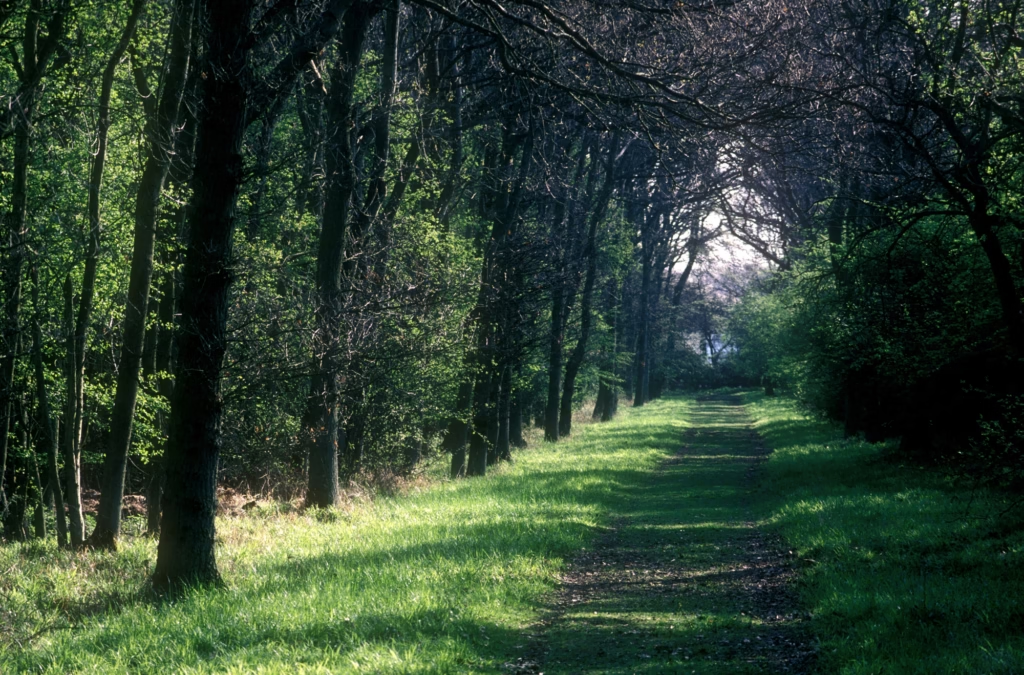
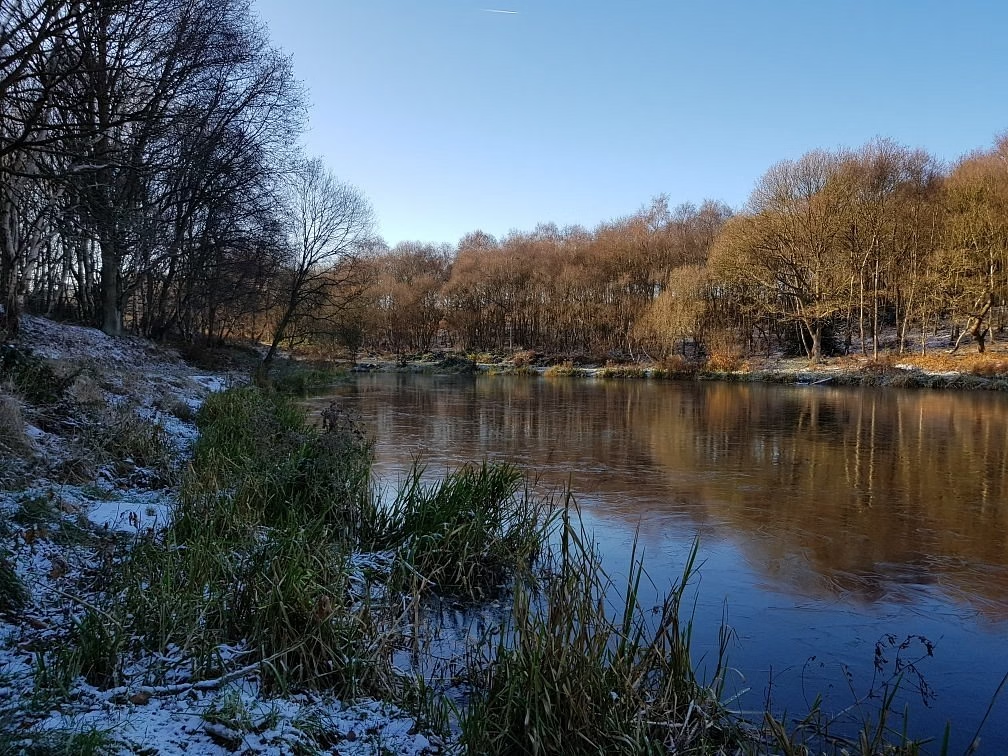
I’ve visited Wombwell Woods before, and it’s a place that has always stayed with me. On the surface, it’s beautiful. Peaceful. Almost idyllic. Tall trees stretch overhead, the paths wind quietly through the woodland, and the ponds sit still, reflecting the sky above. It’s the kind of place you’d expect to feel calm, grounding, somewhere you go to escape noise and stress. But Wombwell Woods has another side. A darker one. And once you’re aware of it, that tranquillity begins to feel more like a distraction.
A Woodland with a Long Memory
Wombwell Woods dates back to medieval times and has long been woven into the history of the surrounding area near Barnsley. Over the centuries, countless people have walked these same trails, and not all of them left peacefully. Despite its modern reputation as a place for walkers, families, and nature lovers, the woods carry stories of brutal murders, tragic suicides, occult practices, and persistent paranormal activity. Stories that refuse to fade, no matter how calm the woods may appear in daylight. There’s an unsettling sense that the land remembers.
Witchcraft, Scrying, and a Dangerous Curiosity
One of the earliest and most chilling tales connected to Wombwell Woods dates back to 1467, involving a local man named William Byg. William is believed to have been one of the earliest known practitioners of scrying, a form of divination using mirrors, water, or reflective surfaces to gain visions or answers. In an era where even whispers of witchcraft could lead to death, William allegedly continued his practices in secret. It’s said he used a crystal ball not just to see visions, but to steal from his neighbours. Eventually, he was caught and punished for crimes of witchcraft, a grim reminder of how dangerous curiosity could be in medieval England. Some believe that whatever William was reaching for never truly left the woods.
The Figure That Shouldn’t Be There
Among the many strange tales surrounding Wombwell Woods, one story is repeated again and again by locals. Visitors have reported a man who bears a striking resemblance to Guy Fawkes, cloaked, old-fashioned, his face partially obscured. He doesn’t linger. He appears suddenly, startling walkers before vanishing just as quickly. One particularly disturbing account comes from a couple driving along a nearby country road. They described seeing a figure run directly into the path of their car, forcing them to brace for impact. But there was no collision. The car passed straight through him. The figure was translucent. And it simply vanished in to thin air!
The Feeling of Being Watched
Many visitors, even during the daytime, report the same sensation, the unmistakable feeling of being watched. Not by one presence, but by many. People describe the sensation as hundreds of unseen eyes following them through the trees, despite nobody else being around. It’s an intense, uncomfortable awareness that doesn’t ease until they leave the woods. At night, that feeling only intensifies.
Lights, Shadows, and Sudden Violence
Wombwell Woods isn’t just known for feelings or fleeting figures. There are darker reports too. Strange luminous balls of light have been seen moving silently between the trees, often leaving witnesses feeling physically unwell afterwards. Others have reported a thick, dark mist that seems to move with purpose, weaving between bushes as though something is hiding within it. Some encounters turn violent. There are accounts of people being attacked by unseen forces; shoved, struck, or overwhelmed to the point of losing consciousness, with no explanation and no visible attacker.
Murder, Suicide, and Lingering Pain
In 2019, tragedy struck Wombwell Woods once again. A man, reportedly devastated by the breakdown of his relationship, entered the woods with the intention of ending his life. Before doing so, he murdered his wife. He attempted to take his own life three times, only succeeding on the third. Locals say the energy of the woods changed after that day. Heavier. More oppressive. But this was far from the first violent act associated with the area.
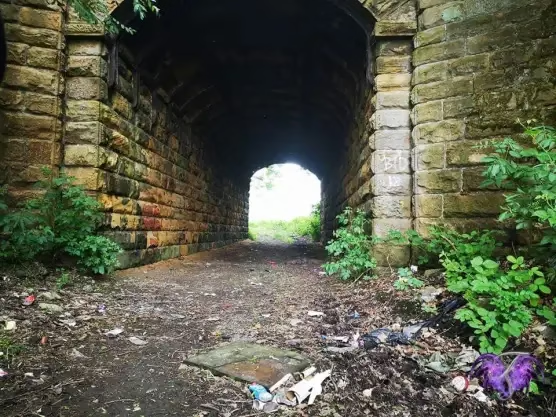
In 1965, Barnsley was terrorised by a child killer later dubbed the Beast of Wombwell. One of his victims, a 14-year-old girl, was brutally stabbed and her body discarded near the border of the woods, close to a tunnel known as Convict Tunnel. Though the killer was later imprisoned for another attack, he never faced justice for her murder. Convict Tunnel itself has its own grim reputation, with reports of apparitions including a monk, a woman walking a terrier dog, and a man believed to have taken his own life within the tunnel.
My Experience in the Woods
While walking through Wombwell Woods, listening to birdsong and the rustling of leaves, there was a constant feeling that I wasn’t alone. Not threatened, just observed. At one point, my phone suddenly died in my hand, despite showing 30% battery. It wouldn’t turn back on. My boyfriend Lee watched it happen. When we returned home hours later, the phone switched itself back on as soon as I stepped inside. The battery read 20%.
Even stranger, during the entire walk, despite having full 5G signal, I received no messages or notifications. When my phone powered back on at home, six unread WhatsApp messages flooded in, all timestamped during the time we were in the woods. Paranormal energy… or just a very inconvenient iPhone? I’ve had devices drain on me before while visiting reportedly haunted locations. This felt familiar.
A Woodland That Refuses to Rest
After spending time in Wombwell Woods, it becomes clear that something lingers there. The atmosphere is heavy. The silence unnatural. Even during the day, unexplained bangs and noises echo through the trees. It may look peaceful, but peace doesn’t always mean absence. Sometimes it just means whatever’s there has learned how to hide.
Parapsychology Notes and Editor’s Analysis (Nick Tyler)
Wombwell Woods is one of those locations where environment, history, and human perception appear to converge. Quiet woodland settings already heighten awareness, the absence of noise encourages the mind to scan constantly for movement, sound, and threat. When a place also carries a reputation for violence, tragedy, and occult association, that heightened awareness can become something far more intense: a persistent sense that you are not alone. That does not automatically mean witnesses are imagining things. In fact, parapsychology has long been interested in places exactly like this, locations where subjective experience is unusually consistent across unrelated visitors.
The sensation of being watched
The feeling described by many visitors to Wombwell Woods, the impression of unseen eyes, of a presence just out of sight, is recognised in both parapsychology and psychology as felt presence, sometimes referred to in older literature as an extracampine hallucination. This term describes the sensation of another being located just beyond the limits of normal perception.
This has been documented by a huge portion of people, not just those who believe in ghosts, and is often triggered by liminal environments, isolation, low light, emotional stress, grief, fatigue, or heightened vigilance, all conditions that can naturally occur in woodland settings. In parapsychological contexts, it frequently accompanies other anomalous experiences such as time distortion, unusual sounds, or electrical interference. What makes Wombwell Woods notable is how often this sensation is reported independently, and how strongly it is felt, even during daylight hours.
Lights, shadows, and physical after-effects
Reports of luminous balls of light, shadowy forms, and dark mist moving between trees are common in haunting folklore worldwide. From a purely environmental perspective, such sightings may be linked to reflections, distant light sources, moisture in the air, or perceptual misinterpretation in low-light conditions. However, parapsychology places particular importance on the witness response, not just the stimulus. Many people report nausea, dizziness, or sudden unease immediately after encountering these lights. Whether these effects are caused by anxiety, environmental factors, or something not yet understood, the body reacts as if a genuine external presence has been encountered and that reaction itself is significant.
Electrical disturbance and “place-bound” anomalies
Lauren’s experience of sudden phone failure in the woods, followed by delayed notifications and the device reactivating only once she returned home, fits into a category often described in investigation circles as electrical disturbance. Batteries draining unexpectedly, devices malfunctioning, and signals behaving inconsistently are frequently reported in allegedly haunted locations.
There are, of course, mundane explanations, battery calibration errors, signal drops, background app failures, but once again, timing matters. The fact that the malfunction occurred only within the woods and resolved immediately upon leaving is precisely the kind of boundary-based detail that witnesses remember most clearly. In research terms, such incidents are not proof, but they are data points, especially when similar experiences are reported by others.
Convict Tunnel and layered folklore
Convict Tunnel, located close to the woodland, is a real and documented structure, a stone underpass built beneath the railway line above. Historical sources suggest the name may stem from stone-mason markings or later folklore rather than confirmed use by convicts, though stories of prisoners, suicides, and apparitions have become firmly attached to the site over time.
This blending of fact and folklore is common in haunted locations. Structures acquire meaning not only through what happened there, but through what people believe happened there. Over time, those beliefs can shape experience.
Violence, memory, and the “Beast of Wombwell”
The nickname “Beast of Wombwell” is historically associated with Peter Pickering and the wider context surrounding the unsolved 1965 murder of 14-year-old Elsie Frost. While some geographical details shift in retellings, the violence itself is well documented, and its proximity to Wombwell and surrounding areas has undoubtedly contributed to the region’s darker reputation.
From a parapsychological standpoint, places linked to unresolved violence often become focal points for haunt narratives, not necessarily because something supernatural is present, but because human memory, fear, and empathy concentrate there.
A recent death, and an unusually fast presence
One particularly unsettling aspect of Wombwell Woods is the suggestion that a presence reported there may be linked to the man who took his own life in the woods in 2019. This is most unusual.
Most reported hauntings are associated with deaths that occurred long ago. Many researchers believe this delay allows time for a residual imprint to form; emotional energy, memory, or repetitive trauma embedded into a location over years or decades.
However, parapsychology also recognises a different category of experience: early visitation phenomena. Across cultures and belief systems, there are hundreds of accounts in which loved ones appear, communicate, or make their presence known moments, hours, or days after death. These experiences are often reported independently, yet share striking similarities.
Such accounts have led some researchers to propose the idea of a temporary overlap between the mortal realm and the afterlife, a liminal period during which consciousness may not yet have fully transitioned. While this remains unproven, its consistency across cultures is difficult to ignore.
If one of the presences reported in Wombwell Woods is indeed linked to a recent death, it raises a troubling possibility: that the individual may never have fully moved on.
Suicide, limbo, and cultural belief
In many cultural and religious traditions, particularly within Christian theology and European folklore, suicide has historically been associated with limbo or purgatory. The soul is thought to exist in a suspended state, unable to progress due to unresolved trauma, guilt, or the sudden nature of death.
Viewed through this lens, it is conceivable that the emotional intensity of the act, combined with the isolation and history of the woods, could anchor a consciousness to the location itself. Not as punishment, but as confusion, a state of being caught between worlds.
This does not suggest certainty. Parapsychology rarely offers absolutes. But it does suggest that recent trauma may sometimes leave a sharper, more immediate imprint than deaths that occurred centuries ago, particularly in places already saturated with violence and loss.
A threshold, not just a woodland
Taken together — the long history of tragedy, the persistent sense of being watched, reports of shadow movement and electrical disturbance, and the proximity of both historic and recent deaths, Wombwell Woods behaves less like a neutral space and more like a threshold. A place where boundaries feel thin.
Where silence feels occupied. Where something may be lingering, perhaps not out of malice, but because it doesn’t know how to leave.
Whether these experiences are psychological, environmental, or genuinely paranormal remains open to interpretation. But the consistency of reports suggests that Wombwell Woods is more than just a quiet place with dark stories. Some locations don’t wait centuries to speak. They whisper almost immediately.
Have you ever visited Wombwell Woods? What did you feel while you were there? Let us know in the comments below 👇